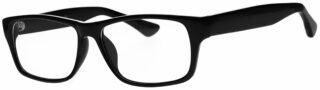
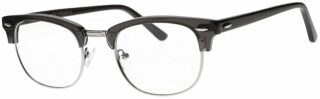
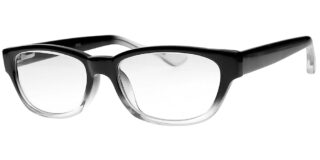
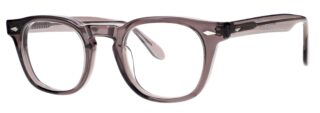
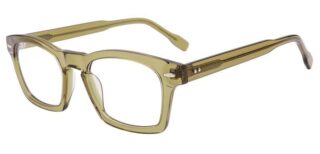

If you are one of the thousands of people who wear reading glasses, you know that the biggest hassle is taking them everywhere and trying to protect them from scratches. More often than not, you may find yourself buying a new pair not because the old pair is broken or the prescription is out of date, but because they have gathered a collection of distracting scratches on the lens. The reason for this? Plastic lenses. From pharmacy ten dollar reading glasses to custom glasses made by your optician, plastic lenses may be considered the cheaper, more commonly used standard but they are generally a bad idea for reading glasses.
Having to wear reading glasses usually means you are at least a little bit far-sighted. Your vision is perfectly functional for normal day-to-day tasks that don’t require focusing closer than a foot from your nose, but those really up-close tasks take a little assistance. This means that your reading glasses go with you everywhere, often hooked onto your pocket, stowed in your work bag, or rattling around in a purse. Sometimes you remember to use the little case, but not always, and sometimes it seems that even if you obsessively use the case, the glasses still get scratched.
With plastic lenses, these scratches can come from anywhere. Scraping against a bag zipper as you stow them, knocking against other items in your bag, or even simply encountering a particularly rough thread in your pockets. Because of the nature of plastic lenses, which are much softer than glass, almost anything can scratch them especially if you live an active lifestyle and are constantly grabbing and stowing your reading glasses.

If you’re tired of constantly replacing your scratched-up reading glasses, it’s time for a solution. Amusingly enough, the answer lies in older technology rather than newer. Plastic lenses have been highly developed in the last few decades and have become the norm for a number of reasons, but if you are a responsible adult in need of some high-quality eyewear, glass is often the better personal choice. When was the last time you saw a glass window scratched, much less so scratched up it can’t be seen through?
It takes a lot more work and a much sharper object to scratch glass lenses, especially in comparison to the softer plastic lenses currently used for most glasses. This means that your reading glasses will remain safe and scratch-free no matter where or how you stow them, in or out of their case, in your pocket with your pens and keys, or in your purse along with a variety of other essentials. Due to their increased durability and scratch resistance, glass lenses are perfect for busy adults who constantly need to quickly access and put away their reading glasses.
For those who wear reading glasses with more than one prescription, as with those using a bifocal or trifocal design, you may have noticed that plastic lenses tend to create something like a color-bleed along the joins. This is called dispersion and often creates a blurry rainbow where the lens is not completely smooth, as with bifocal lines and any scratches. Dispersion also contributes to the Abbe, which is how much light can get through your lenses. As you may have guessed, plastic lenses have both higher dispersion and higher Abbe, increasing the amount of distracting prisms that appear in your vision while simultaneously decreasing visual clarity.
Glass lenses, on the other hand, create clean, dispersion-free bifocal and trifocal joins which do not create prisms and random lines of colored light in your vision while you’re trying to focus. This can be especially important if any of your work takes place outdoors in the sunlight or under a bright office halogen. Glass lenses also have a very low Abbe, letting almost 100% of the light that hits them pass through creating incredible clarity. A low Abbe not only lets you see more clearly, it also allows others to see your eyes without the risk of blinding them with light reflections off your lenses.

Now that you’re considering glass lenses, you may want to think about coatings. Your optician is sure to offer you a few but most of the coating guides assume you have plastic lenses. Because of this, you’ll want to go in with your own list in mind to pair with your new glass lenses. You don’t, for instance, need anti-scratch coating or to worry as much about microfiber cloths because normal t-shirt fabric shouldn’t be able to scratch the glass. However, glass does hold temperature more steadily and is, therefore, more prone to fogging when your environment changes temperature significantly so anti-fog coating is much more advisable. Likewise, most plastic lenses have some amount of UV blocking and if you’d like this feature with glass lenses, you might want to add a UV protection coat.
Reading glasses with real glass lenses are a wonderful way to treat yourself. While children, who go through glasses quickly, may be better off with nearly shatter-proof but scratch-friendly glasses, as a responsible adult on-the-go you deserve better. Whether you work in an office, lead a team of field service professionals, or are enjoying a retirement full of wonderful reading material, reading glasses with glass lenses will stay with you scratch-less and pristine for years, freeing you from the constant hassle of scratches, dispersion, and replacements. If you have any other questions, you can always contact us!

Stay on top of the latest news about prescription safety glasses, eyewear, sunglasses, and all the trends in the industry.
DISCOVER NOWBe the first one to know about promotion, new products, and more.
Follow Us On Instagram @rx_safety















































My interest in going ‘back to’ glass trifocals is because I believe they have ‘no’ join lines between segments, because those are inserted/’cut in’ to the main (distance) lens. Plastic MFs use overlaid segments with tapered edges to prevent peeling-off. That taper is a useless band that intrudes a considerable part of the view, and drives me nuts. No one ever mentions this — doesn’t anyone else notice? or care? Even You mention it only as as a ‘prism’ effect and a possible or minor concern. To me, plastic lenses have been just fine Except for the annoying segment margins. Meanwhile the weight of glass, always mentioned, has Never bothered me. Thank you.
Hi there,
You’ve hit on a highly specific, mechanical detail that most people actually do miss, but for those who notice it, it can be incredibly frustrating! You are definitely not imagining things, and you’re not alone in being driven nuts by it.
What you are describing as a “useless band” on plastic multifocals is the sloped transition zone (or injection-molding seam). Because plastic lined-multifocals (bifocals or trifocals) are molded as a single piece of liquid monomer, or have the segment cast onto the front, the transition between the distance portion and the reading segment cannot be a sharp, perfectly vertical 90-degree cliff. If it were, the lens would be structurally weak and incredibly difficult to pop out of a manufacturing mold without tearing. To make it manufacturable, the machinery requires that slight “taper” or slope. As you noted, that slope creates a zone of completely unusable, distorted vision right at the margin.
You are entirely correct about fused glass lenses. In a glass trifocal or bifocal, the segments aren’t molded into the shape from one uniform material. Instead, a literal “pocket” or countersink is ground into the main crown-glass distance lens. A separate piece of glass with a higher index of refraction (usually flint glass) is placed into that pocket and heated in a furnace until it literally fuses into the main lens.
Because the two types of glass melt together at the interface, the surface of the lens remains perfectly smooth to the touch. There is no physical ridge or molded taper on the outside of the lens to catch the light or disrupt your vision. The “line” you see in a glass multifocal is purely the optical boundary where the two different glass chemistry types meet, not a physical bump or a sloped plastic transition.
If the weight of glass has never bothered you, going back to glass trifocals is an excellent and completely logical choice to eliminate that annoying boundary distortion. It’s a classic example of older optical craftsmanship solving a specific visual problem better than modern mass-produced plastics!
Can you put glass lenses in my existing frames?
Hi there! Yes, we absolutely can put glass lenses into your existing frames.
However, there are a couple of requirements for the frame to safely hold glass:
Full Frame Only: The frame must be a full frame (either plastic or metal) that completely surrounds the lens. We cannot put glass into rimless or semi-rimless (grooved) designs, as glass edges will chip.
Dual Lenses: The frame must use two separate individual lenses (not a single, continuous shield or wrap-around visor style).
As long as your frame fits that description, you are good to go! https://dev.rx-safety.com/shop/lens-replacement-service/safety-glasses-lens-replacement/#
How much do you charge for your glasses and to send to New Zealand also do you use PayPal
Hello,
Shipping out of country generally starts at around $65. After adding a product to your cart, there is the option to do a freight quote before proceeding to check out. We do accept Paypal, as well as all major credit cards.